Подобрать по характеристикам

Готелі та курорти

Готелі та курорти

Ви обрали:
Сортування:
наявність
ціна
алфавіт
Jan Showers
ID: 10457
Видавництво: Abrams

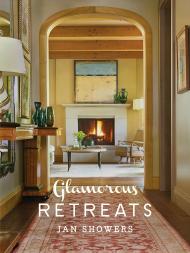
The follow up to the bestselling Glamorous Rooms, Glamorous Retreats takes readers inside Jan Showers's luxurious interiors in vacation locales across North America and the Caribbean, from the mountains of Colorado, to the beaches of Florida and the Caribbean, to the ranches of Arizona and Texas.

With over 200 never-before-seen photographs, this book showcases the renowned designer's elegant eclecticism, which blends Hollywood high style, mid-century modernism, and classic 18th-century French styles, here set within the backdrop of stunning resort destinations. Mixing aspects of the local flavours and lifestyles into her own designs, Showers provides accessible and useful design tenets that will inspire readers to create their own luxurious yet relaxed homes.

The style of the homes will appeal to the dedicated fan base of top designers, celebrities and power players who made her first book a huge success.

Alister MacKenzie
ID: 10245
Видавництво: Classics of Golf

Dr. MacKenzie’s Golf Architecture was a monumental book for its time, a timeless book on golf architecture and a must for any student of the field or serious player. MacKenzie was an outdoorsman, a military man, and a doctor of medicine, whose hobby of golf architecture got the best of him. He ultimately abandoned his medical career to pursue golf course architecture and we must be thankful for that. He fully understood the nuances of the game but his genius was borne from his astute analysis of the nature of the course, its purpose and place in golf. One of the elemental distinctions he made was between strategic hazards (primarily sand bunkers, as he abhorred water as a penalty) and random hazards, as were commonly found on Scottish links—most notably at his beloved St. Andrews.

The penal school of architecture was in vogue during much of MacKenzie’s life but he would have none of it. His conception of a perfect course had to do with surrounding the player, frequently challenging him, but ultimately enabling him the freedom to play, to enjoy his day at golf. MacKenzie felt too many golfers looked on hazards “as a means of punishing a bad shot, when their real object is to make the game interesting.” When his masterpiece, Augusta National Golf Club opened there were only 23 bunkers, barely more than one per hole. “Hazards should be placed with an object, and none should be made which has not some influence on the line of play...” While he is in complete agreement with John L. Low’s 1903 comment in Concerning Golf that no hazard is unfair wherever it is placed, MacKenzie avows “a hazard placed in the exact position where a player would naturally go is frequently the most interesting situation, as then a special effort is needed to get over or avoid it.”

In one of the lectures that constitute this volume, MacKenzie identifies thirteen quintessential traits of the best golf architecture—the thirteen commandments for the zealous. Some are elementary: the next tee should be nearby the last green and in a direction away from following players; every hole should be of a different character and every course should have four par-threes, a couple of drive-and-pitch holes, but mostly substantial par-fours. Many qualities are more complicated: “The course should be so arranged so that the long handicap player, or even the absolute beginner, should be able to enjoy his round in spite of the fact that he is piling up a big score.” Besides ranking as one of the finest volumes on golf architecture, this book is valuable for the good course management it teaches, especially to those neophytes. Golfers must use their minds and act with authority; after all, this is war. MacKenzie was a military specialist in camouflaging earthworks; it was that peculiar skill that shaped his concepts for strategic bunkering.

MacKenzie’s simple formula for a good golf course is twofold: it must never become monotonous; and the best course construction is “almost entirely due to utilization of natural features to the fullest extent and to the construction of artificial ones indistinguishable from nature.” He was also one of the earliest proponents of hazards to putting, designing unique greens such as the seventeenth at Augusta where the vertical halves slope in opposite directions, or the fifth with its backward tiering. He wanted the route to the green to be generous, never lined with ball-gobbling rough or ponds, but he could also be audacious when given property with substantially different terrain, as on the Monterey Peninsula for Cypress Point. Wisely there, the green movement is more tempered due to the high risk factor of many other shots, and perhaps the distracting drama of the surrounds. Admirers of the art of Mackenzie in the U. S. should also view Ohio State University GC, the University of Michigan GC and Crystal Downs CC, Green Hills CC (CA ), Pasatiempo GC, Northwood GC and Stockton G & CC.

While totally serious and eminently important, this book is far from a chore to read. Although a stern, physically imposing Scot, MacKenzie liked a joke, even if at possibly his own expense. One of two rival green shapers admitted he could never quite achieve the subtle contours of the other, and asked his secret.

Paul Daley (Editor)
ID: 10249
Видавництво: Pelican Publishing

This assemblage of beautiful essays and photos looks at the science and art of golf architecture through many different perspectives. Some of the most knowledgeable voices on the topic of golf-course design, including award-winning architects, past presidents of the American Society of Golf Course Architects, and golf magazine editors express their viewpoints on the subject. Among the variety of issues discussed are the placement of hazards, the effects of technology, restoration versus renovation, and the importance of the rhythm of the course. In the first of four volumes, an essay contributed by Tom Doak, the founder and principal of Renaissance Golf Design, explores the meaning of what a golf architect does and is. Doak discusses the extensive use of mathematics required to evaluate variables in the landscape. An essay contributed by Bill Amick, who designed more than seventy-five courses in eight countries, presents the topic of how designs lend to the affordability of membership. In order to achieve cost-efficiency, golf architects must employ a sharp mind and good business sense. Paired with professionalism, golf architects must also have the soul of an artist and a passion for the game. Inspired by the work of Alister Mackenzie, Todd Eckenrode, the U.S. Public Links 1998 Medalist, addresses his affinity for slopes, contours, and a variety of tee shots. Thomas McBroom, who won Golf Digest's award for top course in 2002, includes an essay regarding the dramatic effects of bedrock, and how the traditional obstacles can be utilized for beauty, character, and strategy. Despite the importance of ingenuity, the spirit of creativity remains an important asset.

About the Author

Paul Daley is the author of Links Golf: The Inside Story, which was the second-place winner for the USGA's Golf Book of the Year Award. He is a member of several organizations, including the U.S.-based Tillinghast Association, the Golf Society of Australia, Australian Golf Writers Association, and the Australian Society of Authors. He is also the managing director of Full Swing Golf Publishing. Pelican has also published volumes two and four of Daley's Golf Architecture: A Worldwide Perspective. A member of the National Golf Club in Melbourne, Australia, Daley plays from a handicap of seven.

Paul Daley (Editor)
ID: 10251
Видавництво: Pelican Publishing

An excellent combination of sport, art, and intelligence, golf architecture holds an allure for admirers of courses worldwide.

The complicated process of creating such deceptively simple landscapes has been dissected by the top names in the field. This collection of essays, written by an international array of experts, delves into the complex issues involved in every detail of design. The design of a course is dependent on what elements the designer deems most important. An essay contributed by Jamie Dawson, founder of Enviro Links Design, presents the topic of strategic design interest. This architect takes into account how topography, vegetation, drainage, and fairway routing can contribute to the environmental well-being of a course. Natural landscape is also a concern for Jay Morrish, who was voted golf architect of the year in 1996. He prefers a more literary approach to his design. He likens the detailed craftsmanship of his courses to the careful precision of a poet. Each element must support the other in a beautiful arrangement of natural landscape and manufactured course. Although nature is a large part of any outdoor sports arena, it is often the technological advancements that make the golf course's design sustainable. Karl F. Grohs and Rainer Preissmann, the founding principals of Deutsche Golf Consult, present the topic of improving older courses by updating the existing designs, materials, and buildings to combine the traditional beauty with modern comforts and accessibility. Ronald Fream, an architect with experience in sixty countries, discusses the development of the craft-course design from St. Andrews to the educational and technological advancements that allow new courses to be cost-effective.

About the Author
Paul Daley is the author of Links Golf: The Inside Story, which was the second-place winner for the USGA's Golf Book of the Year Award. He is a member of several organizations, including the U.S.-based Tillinghast Association, the Golf Society of Australia, Australian Golf Writers Association, and the Australian Society of Authors. He is also the managing director of Full Swing Golf Publishing. Pelican has previously published the first two volumes of Daley's Golf Architecture: A Worldwide Perspective. Daley, a member of the National Golf Club in Melbourne, Australia, plays from a handicap of seven.

Paul Daley (Editor)
ID: 10250
Видавництво: Pelican Publishing

Golf is a game that turns even the weekend player into an armchair architect, an enthusiast for the possibilities of golf-course design. In this fourth volume of collected essays, leading golf architects from fifteen countries present their ideas, providing a much-needed international assessment of the principles and practices of golf architecture.

Near the end of the nineteenth century, golf courses moved toward the hearthland, creating the need for thorough reconfiguration of the natural landscape in the clearing of trees and the cultivation of grass to create interesting holes. With the completion of the National Golf Links of America in 1911, the art of golf-course design was born.

The essays and photographs included here represent the tremendous variety of approaches to design principles, from affordability and locality to considerations of the effect of time on the initial design and for specific aspects of the game. The contributors to the book constitute an international "who's who" in the world of golf architecture, with essays from the major golf-course-design firms around the world, award-winning golf architects, and renowned golfers.

About the Editor
Paul Daley is the author of Links Golf: The Inside Story, which was the second-place winner for the USGA?s Golf Book of the Year Award. He is a member of several organizations, including the U.S.-based Tillinghast Association, the Golf Society of Australia, Australian Golf Writers Association, and the Australian Society of Authors. He is also the managing director of Full Swing Golf Publishing. Pelican has previously published the first two volumes of Daley?s Golf Architecture: A Worldwide Perspective. Daley, a member of the National Golf Club in Melbourne, Australia, plays from a handicap of seven.

Paul Daley (Editor)
ID: 10242
Видавництво: Pelican Publishing

About the Author
Paul Daley is the author of Links Golf: The Inside Story, which was the second-place winner for the USGA's Golf Book of the Year Award. He is a member of several organizations, including the U.S.-based Tillinghast Association, the Golf Society of Australia, Australian Golf Writers Association, and the Australian Society of Authors. He is also the managing director of Full Swing Golf Publishing. Pelican has previously published the first two volumes of Daley's Golf Architecture: A Worldwide Perspective. Daley, a member of the National Golf Club in Melbourne, Australia, plays from a handicap of seven.

Dr. Michael J. Hurdzan
ID: 10248
Видавництво: Wiley

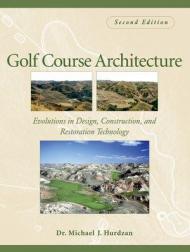
Golf Course Architecture, Second Edition is fully updated with more than fifty percent new material, including more than twenty-five recent innovations in the golf industry. Revealing both the art and science of golf course architecture, it takes readers inside the designer’s mind through each step to designing a golf green, golf hole, and golf course. Beautifully illustrated with hundreds of full-color photographs, course maps, and drawings, this Second Edition explains the roots of ugliness and sources of beauty in courses, how the landscape communicates, and the connection between golfers and golf courses. Golf Course Architecture, Second Edition provides a wealth of accessible and helpful information on golf course architecture chronicling every facet of designing, building, renovating, and restoring a golf course.

James Barrett, Brian Vinchesi, Robert Dobson, Paul Roche, David Zoldoske
ID: 10253
Видавництво: Wiley

Complete guidelines to developing and maintaining the most effective, environment-friendly irrigation systems for golf courses

Golf Course Irrigation offers valuable insight on the design, installation, management, and maintenance of irrigation systems-the most important management tool used on today's golf courses. Without manufacturers' bias, this useful resource provides hands-on guidance to the highest quality irrigation systems, including specifications and applications of the best pump stations, controllers, sprinkler heads, nozzles, valves, sensors, and other components that make the difference in top-quality irrigation systems.

Typically regarded as significant users of water, golf courses are under increasing scrutiny by governmental and environmental groups, making it essential that the up-to-date information found here-on such topics as water supply, plant irrigation requirements, application uniformity, and construction management-be at the fingertips of every golf course professional. While fostering the best playing conditions, these systems conserve water and energy with such technology as low-pressure heads and controls that use "if/then" logic to automatically adjust to changing conditions, which can improve playability while saving money.

Golf Course Irrigation is a practical tool to help golf course architects, builders, superintendents, irrigation consultants, designers, and installers to improve aesthetics and playing conditions in the face of diminishing natural resources. It is also an informative reference for golf course owners, developers, local officials, students, and fans of the game.

Dr. Michael J. Hurdzan
ID: 10257
Видавництво: Wiley

Golf Greens offers a hands-on resource to the design, construction, and history of all types of golf greens.

  • Provides highly illustratative coverage, with a sixteen-page, full-color section featuring shots of old and new greens, greens under construction, and newly finished greens.
  • Provides guidelines for determining best construction methods--with special emphasis placed on site-specific concerns.
  • Covers turfgrass selection with detailed information on artificial turf.
  • Shows how design can be used to make greens fast or slow to match player and course expectations.
Stefan Maiwald
ID: 10255
Видавництво: teNeues
  • With additional information on the featured golf courses, including renowned champions who have played there and the best season to play the course
  • A thoughtful gift for golfers and lovers of luxurious hotels
  • A comprehensive reference including numerous illustrations of golf courses

If there’s a golfer’s heaven, we’re sure it looks something like this! These splendid arrays of lush courses are set in some of the world’s most spectacular locations. Along with stunning landscapes, they offer challenging layouts and unique topography.

We don’t promise you’ll become the next Jack Nicklaus or Martin Kaymer though. Yet, whatever your skill level you’ll surely appreciate the wide array of resort amenities available. Not to mention the world-class architecture and interiors. With venues ranging from the tropics to golf’s ancestral home Scotland, these destinations truly do offer the best accommodations, food, and wine you’ll find anywhere.

Tony Roberts, Michael Bartlett
ID: 10261
Видавництво: ECW Press

Golfers wanting to know the colourful stories behind names like Alcatraz, Biarritz, Cleopatra, Dell, Eden, Postage Stamp, and Redan can now turn to the only book ever devoted exclusively to the par–three hole. In Golf’s Finest Par Threes Tony Roberts and Michael Bartlett have assembled what they call a “an exemplary collection of the most spectacular, historic, challenging, and unusual one–shot holes on the planet.”

The heart of the book is the authors’ list of the 100 greatest par threes in the world, chosen from thousands they’ve seen during more than 30 years profiling and photographing golf courses. These are designated as gold and silver, and arranged by design and geographical categories such as links, island and peninsula, blind, drop shot, and more. Striking photography and fact–filled profiles combine to reveal the distinct character of each hole.

Golf’s Finest Par Threes also explains how the greatest course designers — notably, Macdonald, Colt, Tillinghast, MacKenzie, Ross, Thomas, Jones, Fazio, Nicklaus, Dye, and Doak — have created par threes. A closing section offers new perspectives on the one–shot hole: “Best Sets” and “Out–of–the–Box” threes, historic shots on par threes, and more.

Golf’s Finest Par Threes is a beautifully packaged tour of golf’s great short holes, one guaranteed to inform, entertain, and provoke vigorous debate about what makes a par three superior and memorable.

Bob Cupp, Ron Whitten
ID: 10246
Видавництво: Classics of Golf

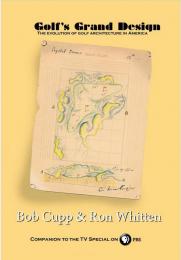
"Golf’s Grand Design," prepared as a companion volume to the PBS documentary of the same name, expands upon the information presented in the television program.

Co-authored by Bob Cupp, one of America’s leading golf course designers, and Ron Whitten, Golf Digest’s longtime senior editor on golf architecture, the book features rare sketches and diagrams of golf holes—some never before published—by 34 past and present golf architects, including Alister MacKenzie, Pete Dye, Bill Coore, Ben Crenshaw, Tom Doak, Gil Hanse, Doug Carrick, Steve Smyers and David McLay Kidd.

In each chapter, based upon one of the drawings, Cupp and Whitten explore a different facet of the course depicted and present unique perspectives into the craft and art of golf course architecture. These sketches are the vehicles by which design becomes grass. They are not AutoCAD plottings used to clear permits (full of technicalities practically indecipherable by everyday folks), but intimate, immediate and sometimes idiosyncratic streams of consciousness that are handed to a bulldozer operator, along with words of instruction, which become reality; the very crux of golf design.These drawings seldom survive; ending up as grocery lists, note pads or even shelf paper. But if one comes back to the designer after the fact - after the hole has been played and proclaimed fun, the drawings become treasures.

Written in a lively conversational format, "Golf’s Grand Design" takes readers behind the scenes in the creation of many of America’s finest courses, from the modest-budget Bully Pulpit in North Dakota to the mega-budget Shadow Creek in Nevada.

The authors retell the discovery of the land that became the groundbreaking Sand Hills Golf Club in Nebraska and relate the extensive process required to complete the environmentally-sensitive Liberty National in New Jersey. They take readers behind the scenes with Jack Nicklaus at work and at play, analyze what made Donald Ross and A.W. Tillinghast such great architects, offer insights into the little-known design talents of PGA Tour Hall of Famers Tom Kite and Tom Watson and pass along revelations regarding such famous holes as “The Cape” and “The Redan.” They conclude with a short discussion of the impact that technology has had on the world of golf.

"Golf’s Grand Design" is intended for all who enjoy golf or who, by virtue of these stories, might consider the game. It provides a fresh approach to understanding and appreciating good golf architecture. It will certainly be one of those books with a long shelf life because its content is not trendy but factual. It is the story of American golf and a living description of the creative process of a game that somehow worked its way into our very souls.

Angelika Taschen
ID: 14401
Видавництво: Taschen

Peak Pleasure. A Mountain Tour of the Alps

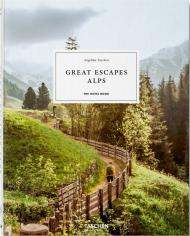
The Alps are Europe’s biggest and greatest mountain range. Formed millions of years ago, they became a popular destination for travelers in the late eighteenth century – first for adventurers and explorers, then for artists and writers, and finally for everyone who wanted to spend summer in the fresh air of this wonderful scenery or take part in winter sports. Angelika Taschen has followed in their footsteps and collected the finest hotels in the Alpine nations of Germany, Austria, Switzerland, France, and Italy.

They include the Kranzbach near Garmisch-Partenkirchen, built for a British aristocrat, Gasthof Hirschen in the Bregenzerwald, where art-loving visitors have been welcomed since 1755, and the Seehof near Salzburg with its emphasis on contemporary art and fine cuisine. The journey goes to Waldhaus Sils in Sils Maria, where many creative guests have found inspiration, to the Schatzalp in Davos, which Thomas Mann immortalized in literature in “The Magic Mountain”, and to picturesque bed & breakfasts with a personal touch such as Brücke49 in Vals and Maison Bergdorf in Interlaken.

High above Chamonix, mountaineers have stayed overnight for more than 140 years at Refuge du Montenvers with its view of the Mer de Glace, the largest glacier in France. In the exclusive Megève, too, which Baroness Noémie de Rothschild put on the tourist map, travelers experience the Alps à la française in the chalet hotel L’Alpaga; and a bit of Italian dolce vita is provided by stunning addresses in the South Tyrol such as the Ottmangut in Merano, Villa Arnica in Lana with its nostalgic atmosphere, and Pension Briol near Barbiano, constructed in 1928 in the Bauhaus style and extended in 2021 with the addition of two extremely modern buildings.

This opulent book of photographs presents the Alpine range and accommodation in large-format images, short texts, and useful details on prices and how to get there. Walkers, skiers, gourmets, and lovers of good living will find valuable tips and very special accommodation: former monasteries where guests still find peace and seclusion, a mountain hut at the heart of the Dolomites, and a youth hostel occupying what was once a sanatorium, a rare example of modern architecture in Switzerland that was declared a heritage monument in 2002.

The editor:

Angelika Taschen studied art history and German literature in Heidelberg, gaining her doctorate in 1986. Working for TASCHEN from 1987, she has published numerous titles on art, architecture, photography, design, travel, and lifestyle.

Texts by:

Christiane Reiter is a freelance author based in Brussels. She studied journalism at the University of Eichstätt and worked as a travel editor for Ringier Publishing in Munich and Zurich. Later, she established the travel section of the Frankfurter Allgemeine Sonntagszeitung.

Angelika Taschen (Editor)
ID: 3024
Видавництво: Taschen

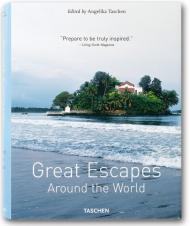
Our selection of the 90 best hotels around the globe

Whether you want to take a relaxing vacation in Asia, a backpacking journey in South America, a road trip in the USA, a cultural tour in Europe, or a safari in Africa, we’ve got the most inspiring and eclectic collection of hotels, guesthouses, boats, lodges, spas, and houseboats that you could ask for. Culled from our Great Escapes series, favorite spots include futuristic-looking, Star Wars-style houseboats made of bamboo poles, palm leaves, and coconut fibers in Kerala, India, as well as a luxury lodge and spa on a java plantation in (you guessed it) Java. An Ayurvedic spa in the Himalayas where nothing matters but peace and relaxation will certainly tempt you, or perhaps you’re more the type for a lush Kenyan open-walled, thatched-roof hut fashioned from tree trunks? On a more modern vibe, oogle Gio Ponti’s sleek blue and white hotel perched on the cliffs in Sorrento, Italy, and you’ll yearn for a sojourn there.
 
Other highlights include an elegant auberge in Napa Valley, California, where you can stay during your wine tasting tour, a historic ranch nestled in a Death Valley oasis, an adobe hotel in the Chilean desert, a hotel built entirely of salt in Bolivia’s Uyuni salt desert, and an “ecolodge” on a natural reserve in the Amazon rain forest. Just flip through the pages of this new compilation of dreamy spots to plan your next holiday, wherever on the planet it may be.
Angelika Taschen (Editor)
ID: 4560
Видавництво: Taschen

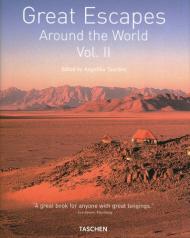
Inspiring getaways from California to Zanzibar

The second installment of Angelika Taschen's round-up of the world's most exceptional hotels and retreats is packed with awe-inspiring photos and tantalizing descriptions of the world's greatest getaways. While few will visit them all, this collection provides a dizzying array of exotic destinations for the armchair traveller.

Highlights include a California inn where Liberace would have felt right at home, and shabby-chic bungalows on Highway 1 in Big Sur. Choose from luxurious residences nestled on the Ubud hillside overlooking the Ayung River in Bali, or oceanside bungalows on a Brazilian archipelago. Go camping in "royal style" in the Indian desert, or opt for a luxury tented camp on an island in the best game-viewing location in Botswana. Relax in a hand-woven banda on Zanzibar, a hotel-museum full of contemporary art on the Sicilian coast, or a sumptuous Provençal spa retreat in the south of France.

показати по:
на сторінці